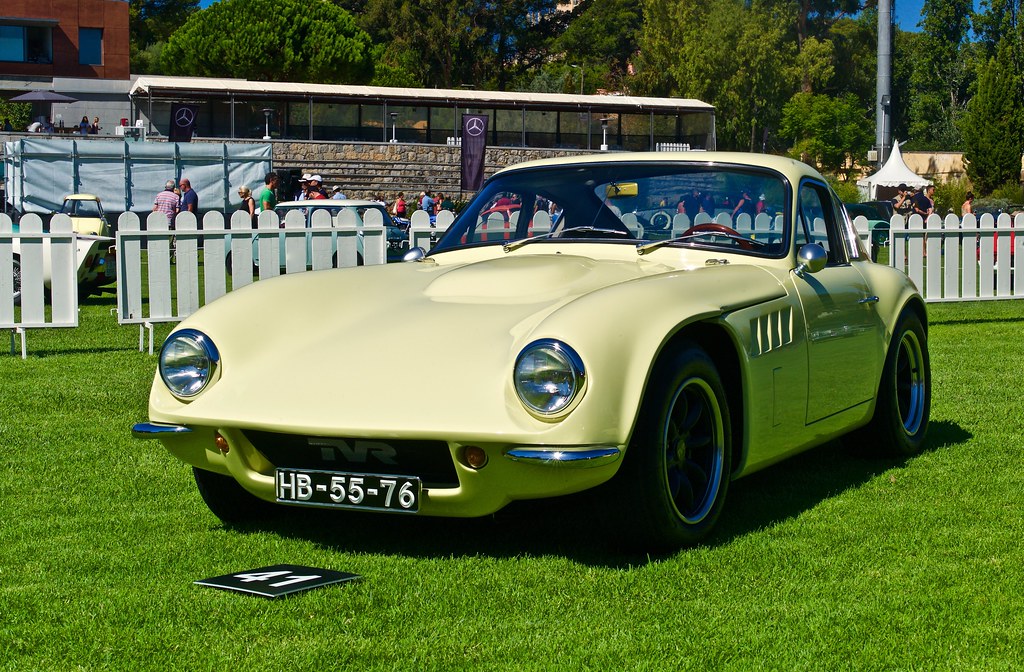
🖼️TVR (Vixen, based on the aging Grantura.)
by Pedro Ribeiro Simões | via flickr | license: CC BY 2.0
Fact Sheet
This record is archived under the More Cars ID 10002533. It was created 8 years, 10 months, 2 days ago. The last update was performed 5 years, 4 months, 4 weeks, 2 days ago.
| Name | TVR (Vixen, based on the aging Grantura.) |
| Description | Cascais Classic Motorshow, Cascais, Portugal HISTORY For the car afficionados TVR stands for extremely powerful engines bolted on ridiculously light and awesome looking carbon fiber bodies. It's the exception from the rule when it comes British car manufacturing, the touch of exotic in an otherwise conservative medium. That's exactly what founder Trevor Wilkinson was thinking about when he started the company in 1947 in Blackpool, Lancastershire. TVR actually is derived from his name, TreVoR and was initially set up to repair and sell cars, but after Wilkinson built his first car by modifying the body on an Alvis Firebird chassis he paired with Jack Pritchard and starting making sports cars. In the beginning, they used existing engines (from BMC or Ford) which severely limited performances for their cars, but at least they made up with great body designs out of fiber-glass and tubular steel frames. The first official TVR model was the Mk 1, later Grantura in 1954. For a long period of time, TVR cars came in kit form in order to exploit a loophole in the tax law, but during the 70s that loophole was fixed and so the cars now came fully assembled. The original owners, Pritchard and Wilkinson left the company in 1962 to set up a new business venture, this time in fiber-glass engineering. The company passed a period of disarray, but it came back strong with the TVR Griffith, named so after the American motor dealer Jack Griffith who thought of sticking a powerful AC Cobra V8 engine into his TVR Grantura. This car would help TVR get back into the game. In 1965, the company changed management again, this time by a TVR shareholder, Martin Lilley who decided to bring a higher level of finishing to the brand. UNDER HIS LEADERSHIP, TVR CAME UP WITH THE FIRST MODEL IN THE TUSCAN SERIES. THE OTHER NEW CAR HE CREATED WAS THE 1968 VIXEN, BASED ON THE AGING GRANTURA. Now having a series of quality products, TVR sought to improve on performance and introduced the M Series chassis that would turn out to be a big hit over in the US. What they still had to borrow was the engine, which throughout the 70s came from Triumphs and Fords. As the 80s dawned, Peter Wheeler came to be manager of TVR and it was he that first introduced turbochargers on TVR engines (at the time TVR was using a Rover V8). Slowly, the need for more powerful engines led to heavy modifications being made to the Rover engine and finally, in the 90s, TVR came up with its own model engine, called the AJP8. The car's bodies would also undergo several important changes under Peter Wheeler. With the turn of the century, and the sale of TVR to Nikolay Smolensky in 2004. Due to drop in demand, a number of employees were let go and headquarters were rumored to move to Turin, Italy. This sparked outrage among fans and customers who rallied in a protest in London. For a while it seemed that the company would close its doors for good, but earlier this year they announced that it would be relaunching a new version of the Sagaris, the Sagaris 2. Read more: <a href="http://www.autoevolution.com/tvr/#ixzz4LaXAaRXB" rel="noreferrer nofollow">www.autoevolution.com/tvr/#ixzz4LaXAaRXB</a> |
| Creator | Pedro Ribeiro Simões |
| License | CC BY 2.0 |
| Tags | TVR, British Car, worldcars |
| Source | https://www.flickr.com/photos/pedrosimoes7/29889914361/ |
| Image URL (original) | https://live.staticflickr.com/8208/29889914361_606929c824_z.jpg |
| Image URL (Size XXL) | https://live.staticflickr.com/8208/29889914361_df5e1cd74a_o.jpg |
| Image URL (Size XL) | https://live.staticflickr.com/8208/29889914361_ef81286448_k.jpg |
| Image URL (Size L) | https://live.staticflickr.com/8208/29889914361_606929c824_b.jpg |
| Image URL (Size M) | https://live.staticflickr.com/8208/29889914361_606929c824_z.jpg |
| Image URL (Size S) | https://live.staticflickr.com/8208/29889914361_606929c824_n.jpg |
| Image URL (Size XS) | https://live.staticflickr.com/8208/29889914361_606929c824_t.jpg |
| Image Provider | flickr |
| External ID | 29889914361 |
| More Cars ID | 10002533 |
| Entry Created | Jun 18, 2017, 7:49 PM |
| Last Updated | Nov 21, 2020, 4:10 PM |